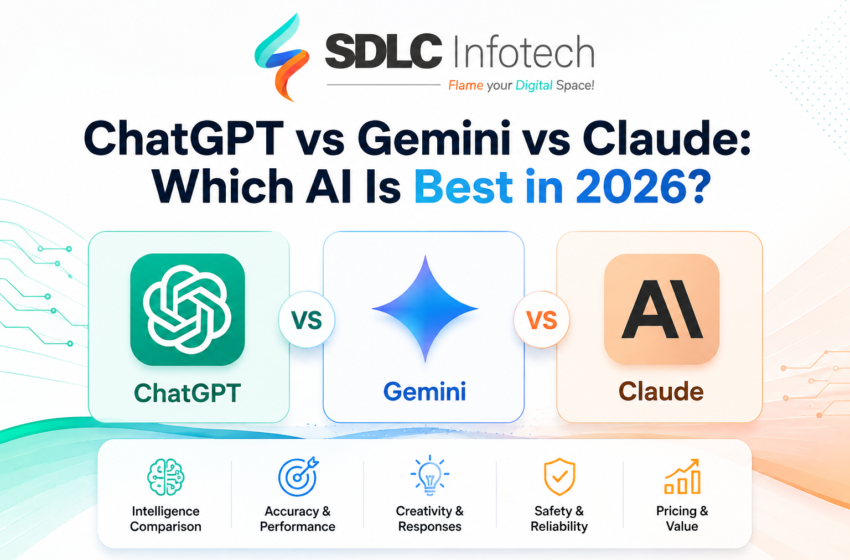
Three assistants dominate the conversation whenever someone asks which AI tool to actually pay for: OpenAI’s ChatGPT, Google’s Gemini, and Anthropic’s Claude. They are not the only options, but they are the three that most students, freelancers, developers, marketers and business teams end up choosing between. Any useful ChatGPT vs Gemini vs Claude comparison has to start with the three names people actually shortlist.
The honest problem with any ChatGPT vs Gemini vs Claude comparison is that the answer keeps moving. In the last four months alone, OpenAI shipped an entirely new model family, Anthropic released four flagship-class models in under two months, and Google shipped three fast Flash models while its top-tier Pro model stayed delayed. A verdict written in January 2026 is already wrong, which is why any ChatGPT vs Gemini vs Claude comparison needs a date on it.
So this ChatGPT vs Gemini vs Claude comparison does two things: it explains what each platform actually is today, with plans and limits as the providers publish them, and it answers the ChatGPT vs Gemini vs Claude question by use case instead of crowning one universal winner.
Information current as of August 2026. Model names, plans, limits and prices in this space change frequently. Verify against the official pages linked at the end before you buy.
Quick answer: The short version of ChatGPT vs Gemini vs Claude is that there is no single best AI in 2026. Claude currently leads independent composite benchmarks and is the strongest pick for long documents, careful reasoning and code quality. ChatGPT has the widest feature set, the best all-round free experience and the deepest third-party app ecosystem. Gemini wins decisively if you live inside Gmail, Docs, Drive and Google Search, and it offers the cheapest routes to capable AI.
ChatGPT vs Gemini vs Claude at a Glance
Here is the ChatGPT vs Gemini vs Claude comparison in summary form before we go deeper into each platform.
| Category | ChatGPT | Gemini | Claude |
|---|---|---|---|
| Developer | OpenAI | Google / Google DeepMind | Anthropic |
| Best for | Broad everyday use, images, apps and agents in one place | Google Workspace users, search-grounded research, low-cost access | Long documents, careful reasoning, professional writing, coding |
| Writing | Very strong, highly steerable, wide range of tones | Competent and improving, occasionally generic on long form | Widely preferred for long-form and editorial prose |
| Coding | Very strong, Codex agent plus IDE and cloud workflows | Strong on the Flash line, Antigravity platform for agentic dev | Very strong, Claude Code is a mature terminal and IDE agent |
| Research | Deep research on paid tiers, limited on Free and Go | Deep Research plus Google Search grounding and NotebookLM | Research mode with connectors, strong source discipline |
| Reasoning | Frontier level on GPT-5.6 Sol | Strong, but the Pro tier has not been refreshed since February 2026 | Currently top of the Artificial Analysis Intelligence Index |
| Long documents | Up to a 400K-token reasoning context on the Pro plan | 1M-token context on current models | 1M-token context across Opus 5, Sonnet 5 and Fable 5 |
| Image capabilities | Generates and understands images | Generates and understands images, Nano Banana model line | Understands images, does not generate them |
| Web / search | Built-in search and a built-in browser | Native Google Search grounding and AI Mode | Web search and fetch with citations |
| Productivity | Projects, tasks, Study Mode, ChatGPT Work, Office extensions | Gmail, Docs, Sheets, Drive, Meet, NotebookLM, Gems | Projects, Skills, Cowork, Chrome, Excel and PowerPoint tools |
| Integrations | Very large app and connector ecosystem | Deepest integration inside Google’s own products | Connectors plus Model Context Protocol, strong developer story |
| Free option | Yes, unlimited everyday chats on the current lightweight model | Yes, and the most generous free tier of the three | Yes, capped by rolling usage windows |
| Paid plans | Go, Plus, Pro (two usage tiers), Business, Enterprise | AI Plus, AI Pro, AI Ultra (two tiers), Workspace bundles | Pro, Max 5x, Max 20x, Team, Enterprise |
| Best for businesses | Broad deployment with admin controls and connectors | Organisations already standardised on Workspace | Document-heavy, analysis-heavy and engineering-heavy teams |
| Best for students | Study Mode and a capable free tier | Best value, frequent student offers and bundled storage | Best for essay structure, source analysis and long readings |
ChatGPT vs Gemini vs Claude: The Models Behind Each Platform in 2026
This is where most ChatGPT vs Gemini vs Claude comparisons go wrong, so it is worth separating four different things: the product you open, the model running underneath, the API model ID developers call, and the plan that decides which of those you can reach.
OpenAI
ChatGPT is the product, and it is the most recognised name in any ChatGPT vs Gemini vs Claude comparison. The current model family is GPT-5.6, which became generally available on 9 July 2026 in three tiers: Sol (flagship), Terra (balanced) and Luna (fast and low cost). Pro and Enterprise users can also select GPT-5.6 Sol Pro in standard chat. Since 6 August 2026, GPT-5.6 Luna is the default model on Free and Go, with unlimited everyday text chats subject to abuse guardrails. Older GPT-5.x models remain selectable as legacy options on paid plans and are retired on a rolling schedule.
Gemini is both the app and the model family, which is one reason ChatGPT vs Gemini vs Claude naming confuses people. The Pro tier is still led by Gemini 3.1 Pro, released 19 February 2026, alongside Gemini 3 Deep Think for heavier reasoning. The Flash line has moved much faster: 3.5 Flash in May, 3.6 Flash and 3.5 Flash-Lite in July, and 3.7 Flash on 13 August 2026. Gemini 3.5 Pro was announced at Google I/O in May 2026 but was still not broadly available in mid-August, with Google confirming partner testing only and saying pre-training has begun on Gemini 4.
Anthropic
Claude arrived last of the three in mainstream use, but it now leads several benchmarks in this ChatGPT vs Gemini vs Claude comparison. Claude is the product; the model tiers are Haiku, Sonnet, Opus and the newer Mythos class above Opus. Current lineup: Claude Opus 5 (24 July 2026, the flagship and default on Max), Claude Sonnet 5 (30 June 2026, the default on Free and Pro), Claude Haiku 4.5, and Claude Fable 5, the publicly available Mythos-class model. Claude Mythos 5 shares Fable 5’s underlying model without the same safeguard layer and is restricted to approved organisations under Project Glasswing.
Model information in this ChatGPT vs Gemini vs Claude comparison last verified: 19 August 2026. Model availability changes often, and access varies by plan and region.
ChatGPT in 2026
ChatGPT is the most widely used general assistant, and its main advantage is breadth. In a ChatGPT vs Gemini vs Claude comparison, that breadth is its defining trait. In one interface you get chat, reasoning, web search, a built-in browser, image generation and editing, voice, file analysis, data analysis with Python, Projects, scheduled tasks, custom GPTs, Study Mode, the Codex coding agent and ChatGPT Work for connected knowledge work.
Strengths. The free plan is genuinely usable now, with unlimited everyday text chats. Image generation is built in and good. The app and connector ecosystem is the largest of the three, which matters if you want AI that touches Slack, Drive, Gmail, Excel or PowerPoint without custom work. On reasoning, GPT-5.6 Sol sits at the frontier and is notably token-efficient, which is why it also does well on agent workloads.
Weaknesses. The plan ladder is the most complicated in the category: Free, Go, Plus, two Pro usage tiers, Business and Enterprise, with meaningful differences in which model you actually reach. Free and Go do not get Sol in standard chat. Advertising has been introduced on the cheapest tiers in some markets. Consumer tiers use conversations for training by default, with an opt-out; Business and Enterprise do not. Plan complexity is its biggest liability in the ChatGPT vs Gemini vs Claude lineup.
Writing and coding. Writing is very good and very steerable, though on long editorial pieces it can drift toward a recognisable house style unless you push it. Coding is strong: Codex handles local edits, cloud tasks and pull requests, and GPT-5.6 Sol leads Artificial Analysis’s Coding Agent Index inside OpenAI’s own Codex harness.
Documents. Context on ChatGPT is plan-dependent: roughly 256K tokens of reasoning context on Go and Plus, 400K on Pro, and a much smaller window on the Instant model. That is the ceiling to know before you paste a 300-page report.
Who should use it. People who want one tool that does the most things, anyone who needs image generation alongside text, and teams that want the widest integration surface. It is the safest default for anyone weighing ChatGPT vs Gemini vs Claude for the first time.
Google Gemini in 2026
Gemini is the assistant plus the model family plus a layer running quietly inside products most people already use: Search AI Mode, Gmail, Docs, Sheets, Drive, Meet, Chrome, Android and NotebookLM. That distribution is its real argument in any ChatGPT vs Gemini vs Claude comparison.
Strengths. Distribution and price. The free tier is the most generous of the three, Google AI Studio still gives developers free API access to Flash models with rate limits, and the paid ladder starts below the $20 mark that OpenAI and Anthropic anchor to. Deep Research browses and synthesises across many sources, image generation through the Nano Banana line is excellent, and the current models carry 1M-token context. If your documents live in Drive, nothing else is this close to your data.
Weaknesses. The flagship story is messy. Gemini 3.1 Pro has not been replaced since February 2026, and Gemini 3.5 Pro has slipped repeatedly, with Google shipping Flash releases instead. On composite benchmarks that means Google’s top tier now sits behind the newest Anthropic and OpenAI flagships, even while its Flash models lead on speed and cost. Feature availability is also uneven: several 2026 features launched US-only or English-only first, which matters for readers in India. The stale Pro tier is the weakest link in Google’s ChatGPT vs Gemini vs Claude position.
Reasoning and coding. Gemini 3 Deep Think targets hard reasoning, and 3.7 Flash was released specifically for better debugging and production-ready code at lower token cost. Antigravity is Google’s agent-first development platform.
Google Workspace relevance. Gemini is bundled into Workspace Business Standard, Plus and Enterprise rather than sold as a standalone add-on. For an organisation already paying for Workspace, that is often the cheapest capable AI you can deploy.
Who should use it. Google Workspace organisations, students and cost-sensitive users, researchers who want search-grounded answers, and anyone doing heavy image or video generation work. If your work lives in Google’s tools, ChatGPT vs Gemini vs Claude is a short conversation.
Claude in 2026
Claude is the most focused of the three. Anthropic has invested less in consumer breadth and more in reasoning quality, long-context work, coding agents and enterprise controls.
Strengths. As of mid-August 2026, Claude Opus 5 leads the Artificial Analysis Intelligence Index, and Claude Fable 5 sits at or near the top of LMArena’s text leaderboard, which measures human preference rather than test scores. All current models carry a 1M-token context window, so a 700-page contract set or a large codebase fits in one session. Claude Code is a mature coding agent, and Cowork, Skills, connectors and Model Context Protocol support give it a strong automation story. Anthropic publishes unusually detailed system cards and safety evaluations, which some regulated buyers weigh heavily. That benchmark position is the strongest single claim in the ChatGPT vs Gemini vs Claude comparison right now.
Weaknesses. No image or video generation, which rules it out as a single tool for creative teams. The consumer ecosystem is smaller, with fewer consumer-facing integrations than ChatGPT or Gemini. Usage is governed by rolling session windows plus weekly caps, which heavy users do hit. And Anthropic’s own release history shows the risk of depending on a frontier model: access to Fable 5 and Mythos 5 was suspended on 12 June 2026 under a US export-control directive and restored on 1 July 2026.
Writing. This is the most consistent qualitative advantage Claude holds. For long-form editorial writing, structured argument and editing someone else’s prose without flattening it, it is the model most professional writers reach for.
Long documents. The combination of 1M-token context, high output limits and adaptive thinking makes it the strongest of the three at reading a large document set and answering precisely from it.
Who should use it. Writers, analysts, lawyers, researchers, developers and any team whose core work is reading and producing long, careful text. Of the three, it is the specialist pick in the ChatGPT vs Gemini vs Claude lineup.
ChatGPT vs Gemini
This is the most searched pairing inside the wider ChatGPT vs Gemini vs Claude question. On raw reasoning, ChatGPT currently has the edge: GPT-5.6 Sol sits at the frontier of composite benchmarks while Gemini’s Pro tier has not been refreshed since February. On accuracy for current events, Gemini’s native Search grounding gives it an advantage, and its Deep Research reports are excellent for breadth.
Writing is close, with ChatGPT more steerable and Gemini sometimes more generic on long form. On coding, ChatGPT’s Codex is the more complete end-to-end agent, while Gemini’s Flash models are dramatically cheaper per token, which matters at volume. Multimodal work is Gemini’s strongest suit overall once video generation enters the picture.
On productivity, this comes down to where your work lives. ChatGPT reaches into more third-party apps; Gemini reaches deeper into Google’s own. Free plans favour Gemini for capability and ChatGPT for uninterrupted chat volume. Paid plans sit at roughly the same $20 tier, though Google bundles storage and consumer extras that OpenAI does not.
Winner for most users: ChatGPT. It is the better general-purpose assistant for people who are not already committed to Google’s ecosystem, mainly because of feature breadth, image generation and integration depth. But that flips completely for Workspace organisations, where Gemini’s placement inside Gmail, Docs and Drive saves more time than any benchmark difference.
ChatGPT vs Claude
This pairing is the closest call in the ChatGPT vs Gemini vs Claude comparison. For writing quality, especially long-form, Claude is the more common professional preference and currently leads human-preference leaderboards. ChatGPT is more versatile across formats and better when you want image, chart and document output from the same conversation.
Coding is genuinely close and depends on workflow. Claude Opus 5 leads composite intelligence and agentic scores; GPT-5.6 Sol leads the Coding Agent Index inside Codex. Teams report different winners on different codebases, and the evidence does not support a clean verdict either way.
For reasoning, Claude currently holds the top composite score. For document analysis, Claude’s 1M-token context beats ChatGPT’s plan-limited windows. For creativity outside prose, ChatGPT wins because Claude cannot generate images. On pricing, the headline tiers match at $20, $100 and $200, and both charge separately for API usage.
Verdict by use case: choose Claude if your work is reading and writing long text or shipping code; choose ChatGPT if you need one assistant covering text, images, voice, browsing and app connections.
Gemini vs Claude
The last pairing in the ChatGPT vs Gemini vs Claude comparison is the most lopsided by category. Claude wins on writing quality, reasoning depth and document analysis. Gemini wins on research breadth, price, multimodal output and anything touching Google’s ecosystem.
On long-context work both offer 1M tokens, but they use it differently: Claude is better at precise recall and careful synthesis across a large document set, while Gemini is cheaper for processing high volumes. On coding, Claude Code is the stronger interactive agent; Gemini’s Flash models are the better economic choice for large automated workloads.
For business use, the deciding factor is usually infrastructure. Workspace organisations get Gemini bundled. Teams that need document-heavy analysis, engineering agents and detailed model documentation lean Claude.
Verdict by use case: Gemini for research, cost efficiency and Google-native work; Claude for depth, accuracy and professional text.
ChatGPT vs Gemini vs Claude: Best AI for Different Use Cases
This is where the ChatGPT vs Gemini vs Claude comparison stops being abstract. The verdicts below are by task.
Which AI Is Best for Writing?
Claude. It leads human-preference text rankings, holds structure across very long pieces, and edits existing prose without rewriting the author’s voice. ChatGPT is a close second and better when the piece needs images or formatted deliverables. On writing, the ChatGPT vs Gemini vs Claude gap is real but narrow.
Which AI Is Best for Coding?
Close call between Claude and ChatGPT. Claude Opus 5 leads composite intelligence and agentic benchmarks; GPT-5.6 Sol leads the Coding Agent Index in Codex while using fewer tokens. Pick by workflow: Claude Code for interactive, repository-level work; Codex for cloud tasks and pull-request automation. Gemini’s Flash line is the value option at scale. Coding is the least settled part of the ChatGPT vs Gemini vs Claude comparison.
Which AI Is Best for Research?
Gemini, narrowly. Search grounding, Deep Research and NotebookLM together cover discovery, synthesis and source management better than anything else, and much of it is available free. Use Claude when the research is deep rather than wide, such as analysing twelve long PDFs rather than scanning a hundred pages.
Which AI Is Best for Students?
Gemini. It offers the strongest free tier, frequent student promotions, bundled storage and direct integration with Docs and Drive. ChatGPT’s Study Mode is a genuinely good learning feature, and Claude is the better choice for essay work and dense reading. Most students comparing ChatGPT vs Gemini vs Claude should simply start free.
Which AI Is Best for Businesses?
It depends on your stack. Google Workspace organisations should default to Gemini. Companies wanting the widest integration surface and general employee adoption tend toward ChatGPT Business or Enterprise. Firms whose work is document analysis, drafting or software engineering get more from Claude Team or Enterprise. All three offer admin controls and no training on business data by default on their business tiers. For buyers, ChatGPT vs Gemini vs Claude is a procurement question as much as a capability one.
Which AI Is Best for Marketing?
ChatGPT, for the practical reason that campaign work needs copy, images, data analysis and app connections in one place. Claude is better for long-form content and thought-leadership drafting; Gemini is better for SEO research grounded in live search results.
Which AI Is Best for Long Documents?
Claude. A 1M-token context is available across its current models rather than reserved for the top plan, and it is the most reliable of the three at answering precisely from a large document set. Nothing else in the ChatGPT vs Gemini vs Claude comparison changes this one.
Which AI Is Best for Google Workspace Users?
Gemini, with no serious argument against it. It is bundled into Business Standard and above, and it can act on Gmail, Docs, Sheets and Drive content directly.
Which AI Is Best for Developers?
Claude for code quality, ChatGPT for agent workflows, Gemini for cost. Claude’s Model Context Protocol has become a common integration standard; OpenAI’s Codex has the most complete task-to-pull-request pipeline; Gemini Flash offers the lowest price per token among the three at frontier-adjacent quality.
Which AI Is Best for Content Creators?
ChatGPT or Gemini, because both generate images and Claude does not. Choose Gemini if video generation matters, ChatGPT if you want text, images and publishing workflows in one tool.
ChatGPT vs Gemini vs Claude in Real-World Scenarios
The ChatGPT vs Gemini vs Claude comparison looks different once you frame it as tasks rather than features.
| Task | Best choice | Why |
|---|---|---|
| Write a 2,000-word blog post | Claude | Holds structure and voice across long drafts better than the others |
| Analyse a 300-page contract set | Claude | 1M-token context plus precise recall from large document sets |
| Build and ship a feature | Claude or ChatGPT | Claude Code for repository work, Codex for cloud tasks and PRs |
| Research an unfamiliar market | Gemini | Search grounding plus Deep Research covers breadth fastest |
| Summarise a meeting or report | Any of the three | All handle this well; pick whichever holds your files |
| Create marketing campaign ideas and visuals | ChatGPT | Ideas, copy and image generation in one conversation |
| Study for an exam | Gemini or ChatGPT | Gemini for free capacity; ChatGPT Study Mode for guided practice |
| Daily business productivity in Google Workspace | Gemini | It already sits inside Gmail, Docs, Sheets and Drive |
| High-volume automated processing | Gemini | Flash-class models are the cheapest per token of the three |
| Draft a sensitive client email | Claude | Best judgement on tone in professional correspondence |
Run the ChatGPT vs Gemini vs Claude question against real tasks and the split shows up clearly. Across these ChatGPT vs Gemini vs Claude scenarios, Claude and Gemini each win three and ChatGPT wins two outright, with several shared. That distribution is the real answer to the question.
ChatGPT vs Gemini vs Claude Pricing in 2026
On price, ChatGPT vs Gemini vs Claude has converged almost exactly. Prices and plan availability can vary by region and may change. The figures below are US list prices unless stated. Subscriptions and API access are billed separately on all three platforms.
| Plan level | ChatGPT | Gemini (Google AI) | Claude |
|---|---|---|---|
| Free | $0, unlimited everyday chats on GPT-5.6 Luna, limited uploads, images, voice and deep research | $0, includes current Flash model, image generation, Deep Research and limited Pro access | $0, Sonnet 5 with rolling usage limits |
| Entry paid | Go, $8/month | AI Plus, roughly $5 to $8/month depending on market and date | No equivalent tier |
| Standard paid | Plus, $20/month | AI Pro, $19.99/month | Pro, $20/month, or $17/month billed annually |
| Higher tier | Pro, $100/month (5x) or $200/month (20x) | AI Ultra, $99.99 (5x) or $199.99 (20x) | Max, $100/month (5x) or $200/month (20x) |
| Team / business | Business, about $20/seat annual or $25 monthly, 2-seat minimum | Bundled into Workspace Business Standard, Plus and Enterprise | Team, $20/seat annual or $25 monthly; Premium seats $100 annual or $125 monthly, 5-seat minimum |
| Enterprise | Custom | Gemini Enterprise, custom | $20/seat/month plus usage at API rates, billed annually |
India note. All three price locally. ChatGPT has offered Go at ₹399/month with promotional free periods, Plus at around ₹1,999. Google AI Plus has been offered from roughly ₹399/month after introductory pricing, with AI Pro around ₹1,950. Anthropic introduced INR pricing in 2026 with Pro reported at roughly ₹2,399/month. Promotional offers in India change frequently, so check the provider’s current pricing page from your own account before subscribing. Local pricing is where the ChatGPT vs Gemini vs Claude decision often gets settled in India.
Developer pricing, per million input/output tokens at the time of writing: GPT-5.6 Sol $5/$30, Terra $2/$12, Luna $0.20/$1.20; Gemini 3.7 Flash $0.75/$3.75 introductory; Claude Opus 5 $5/$25, Sonnet 5 $2/$10, Haiku 4.5 $1/$5, Fable 5 $10/$50.
ChatGPT vs Gemini vs Claude: Features Compared
Feature parity across the ChatGPT vs Gemini vs Claude lineup is high, with a few decisive gaps. Key: ✓ available · △ limited or plan-dependent · — not available
| Feature | ChatGPT | Gemini | Claude |
|---|---|---|---|
| Web search | ✓ | ✓ | ✓ |
| Deep research mode | △ (limited on Free and Go) | ✓ | ✓ |
| Extended reasoning | ✓ | ✓ | ✓ |
| Coding agent | ✓ (Codex) | ✓ (Antigravity) | ✓ (Claude Code) |
| Image generation | ✓ | ✓ | — |
| Image understanding | ✓ | ✓ | ✓ |
| File uploads | △ (limited on Free) | ✓ | ✓ |
| 1M-token context | △ (plan-dependent in chat) | ✓ | ✓ |
| Voice | ✓ | ✓ | ✓ |
| Projects / workspaces | ✓ | ✓ (Gems) | ✓ |
| Agents and automation | △ (plan-dependent) | △ (Spark, select plans and countries) | ✓ (Cowork, Agent SDK) |
| Custom assistants | △ (creating GPTs needs a paid plan) | ✓ | ✓ (Projects and Skills) |
| Third-party integrations | ✓ | ✓ | ✓ (connectors and MCP) |
| API access | ✓ | ✓ | ✓ |
| Business admin controls | ✓ (Business and Enterprise) | ✓ (Workspace and Gemini Enterprise) | ✓ (Team and Enterprise) |
What the Benchmarks Say
Independent benchmarks are the closest thing to a neutral ChatGPT vs Gemini vs Claude scorecard. Two references are worth citing, both read on 18 to 19 August 2026.
Artificial Analysis Intelligence Index (v4.1.x), a composite of ten benchmarks including GPQA Diamond, Humanity’s Last Exam and Terminal-Bench, tested at maximum reasoning effort: Claude Opus 5 leads at 63, followed by Claude Fable 5 at 62 and GPT-5.6 Sol at 61. Google’s Gemini 3.1 Pro sits below that group, which is consistent with it being a February 2026 model.
Artificial Analysis Coding Agent Index (v1.1): GPT-5.6 Sol scored 80 running in OpenAI’s Codex harness, ahead of Claude Fable 5.
LMArena, which ranks by anonymous human A/B preference rather than test scores, has placed Claude Fable 5 at the top of its text leaderboard and Claude Opus 5 top of its coding boards.
Three caveats matter. Scores depend heavily on effort settings and the test harness, so the same model can rank differently in two tests. Composite indices weight benchmarks by their own methodology, not by your workload. And none of this predicts how a model performs on your documents, in your codebase, in your language. Treat these ChatGPT vs Gemini vs Claude leaderboards as a shortlist tool, not a purchase decision.
So, Which AI Is Best in 2026?
Here is the ChatGPT vs Gemini vs Claude verdict in one place, by category.
- Best overall: ChatGPT for the largest number of people, on breadth rather than raw capability. Claude if you weight output quality above feature count.
- Best for writing: Claude.
- Best for coding: Claude and ChatGPT are tied, split by workflow rather than by capability.
- Best for research: Gemini.
- Best for Google users: Gemini.
- Best for business: Depends on your stack. Gemini for Workspace organisations, ChatGPT for broad adoption and integrations, Claude for document and engineering-heavy teams.
- Best for students: Gemini, on value and free capacity.
- Best for long documents: Claude.
There is no single winner for every user. The ChatGPT vs Gemini vs Claude answer changes with the job in front of you. The three platforms have converged on price and diverged on shape. At $20 a month you are not choosing more or less intelligence, you are choosing which ecosystem your work sits inside and which kind of output you need most. The advice we give clients facing the ChatGPT vs Gemini vs Claude choice is to run the free tier of all three against one real task from your own week, then pay for whichever saved the most time. If your work is writing or code, start with Claude. If it is everything else, start with ChatGPT. If your company runs on Google Workspace, you may already be paying for Gemini. And treat none of it as permanent: model leadership in the ChatGPT vs Gemini vs Claude race has changed hands three times in 2026 alone.
Frequently Asked Questions
Common questions about ChatGPT vs Gemini vs Claude, answered briefly.
Is ChatGPT better than Gemini in 2026?
For general-purpose use outside Google’s ecosystem, yes. ChatGPT has broader features, a more capable current flagship model and a much larger app ecosystem. Gemini wins on price, free-tier generosity, search-grounded research and anything involving Gmail, Docs, Sheets or Drive. If your work already lives in Google Workspace, Gemini will usually save you more time than ChatGPT’s extra features will. That pairing is the closest call in ChatGPT vs Gemini vs Claude for everyday users.
Is Claude better than ChatGPT for writing?
Most professional writers say yes, and human-preference leaderboards currently agree. Claude holds structure across long pieces and edits existing prose without erasing the author’s voice. ChatGPT is more versatile: it is better when the piece needs images, charts or formatted documents produced in the same session, and it is more steerable if you want a very specific tone.
Which AI is best for coding in 2026?
The evidence is genuinely split. Claude Opus 5 leads composite intelligence and agentic benchmarks, while GPT-5.6 Sol leads the Coding Agent Index inside OpenAI’s Codex harness at lower token cost. Choose Claude Code for interactive repository work and Codex for cloud tasks and pull-request automation. For high-volume automated coding, Gemini’s Flash models are far cheaper per token. Coding stays the most contested category in ChatGPT vs Gemini vs Claude testing.
Which AI is best for research?
Gemini, mainly because Google Search grounding, Deep Research and NotebookLM cover discovery, synthesis and source management together, much of it on the free tier. ChatGPT’s deep research is excellent but limited on Free and Go plans. Claude is the better choice when the research means reading a small number of long documents very carefully rather than scanning many sources.
Which AI is best for students?
Gemini offers the best value: the strongest free tier, regular student promotions and bundled storage. ChatGPT’s Study Mode is a well-designed learning feature that walks through problems instead of answering them. Claude is the strongest for essay planning, structuring arguments and working through long readings. Many students use the free tiers of two of them.
Is Gemini better if I use Google Workspace?
Yes. Gemini is bundled into Workspace Business Standard, Plus and Enterprise rather than sold separately, and it can act directly on Gmail, Docs, Sheets and Drive content with your existing permissions. Both ChatGPT and Claude offer Google connectors, but neither sits natively inside those apps the way Gemini does.
Is Claude better for long documents?
Generally, yes. All current Claude models carry a 1M-token context window regardless of tier, and Claude is the most reliable of the three at answering precisely from a large set of documents. Gemini also offers 1M tokens and is cheaper at volume. ChatGPT’s chat context is plan-dependent, running to roughly 400K tokens on the highest tier.
Which AI has the best free plan?
Gemini’s free tier is the most capable overall, including image generation, Deep Research and some access to Google’s Pro model. ChatGPT’s free plan now allows unlimited everyday text chats but limits uploads, images, voice and deep research. Claude’s free plan gives you a strong model with rolling usage caps you will hit quickly in serious work. Free tiers are the cheapest way to run your own ChatGPT vs Gemini vs Claude test.
Which AI is best for business?
There is no universal answer. Google Workspace organisations should start with Gemini, companies wanting broad adoption and the widest integrations usually pick ChatGPT Business or Enterprise, and document or engineering-heavy teams get more from Claude Team or Enterprise. All three exclude business-tier data from model training by default and offer admin controls, SSO and audit tooling at the enterprise level. Treat ChatGPT vs Gemini vs Claude as a stack decision, not a shortlist of chatbots.
Should I use ChatGPT, Gemini, or Claude?
The ChatGPT vs Gemini vs Claude decision comes down to your main task, not the leaderboard. Writing and long documents: Claude. Google Workspace and research: Gemini. Everything in one place, including images: ChatGPT. Settle ChatGPT vs Gemini vs Claude by testing all three free tiers on one real task from your own work before paying. Many professionals end up paying for one and using another’s free tier for second opinions.
Further Reading
If this ChatGPT vs Gemini vs Claude comparison helped you shortlist a tool, the next question is usually how to build around it. If you are building an AI workflow rather than just picking a chatbot, these related guides go deeper:
- Our tested roundup of 100 free AI tools worth using in 2026 covers the specialist tools that sit around a general assistant.
- If you want to earn from these skills, we have mapped the AI side hustles that actually make money.
- For a longer view on the job market, see the careers that are hardest for AI to replace.
- For voice work specifically, our guide to the best AI voice tools in India compares realism, language support and pricing.
Choosing the tool is the easy part. Getting AI into your actual systems, with the right data, permissions and fallbacks, is where most projects stall. SDLC Infotech has spent 14 years building software, websites and digital infrastructure that businesses run on, and our team in Noida can help you work out whether a $20 subscription solves your problem or whether you need something built properly. We help clients work through ChatGPT vs Gemini vs Claude decisions and then implement them.
Sources
| Source | URL | Information supported |
|---|---|---|
| OpenAI, GPT-5.6 announcement | openai.com/index/gpt-5-6 | GPT-5.6 Sol, Terra, Luna tiers and API pricing |
| OpenAI Help Centre, model release notes | help.openai.com | Model availability and retirement schedule |
| ChatGPT pricing page | chatgpt.com/pricing | Plan structure, model access, context windows, feature availability |
| OpenAI Help Centre, ChatGPT Go | help.openai.com | Go plan inclusions and availability |
| Google, Gemini 3.5 announcement | blog.google | Gemini 3.5 Flash release and Pro status |
| Google, Gemini 3.6 Flash and Flash-Lite | blog.google | July 2026 Flash releases, 3.5 Pro partner testing, Gemini 4 pre-training |
| Google, AI subscription updates from I/O 2026 | blog.google | AI Plus, Pro and Ultra tiers and usage multiples |
| Google AI for Developers, models | ai.google.dev | Current Gemini model IDs and capabilities |
| Google One, AI plans | one.google.com | Plan inclusions, storage, country availability |
| Axios, Gemini 3.7 Flash | axios.com | 13 August 2026 release and introductory token pricing |
| TechCrunch, Google’s July model releases | techcrunch.com | Gemini 3.5 Pro delay context |
| Anthropic, Introducing Claude Opus 5 | anthropic.com | Opus 5 capabilities, positioning and pricing |
| Anthropic, Introducing Claude Sonnet 5 | anthropic.com | Sonnet 5 release, pricing and availability |
| Claude Platform docs, models overview | platform.claude.com | Model lineup, Fable 5 and Mythos 5 availability |
| Claude Platform docs, pricing | platform.claude.com | Current API rates |
| Claude plans and pricing | claude.com/pricing | Pro, Max, Team and Enterprise plan structure |
| Anthropic Help Centre, release notes | support.claude.com | Fable 5 and Mythos 5 access restoration, admin controls |
| Artificial Analysis, LLM leaderboard | artificialanalysis.ai | Intelligence Index and Coding Agent Index scores |
| Axios, Anthropic releases Opus 5 | axios.com | Opus 5 launch details and positioning |