
Hiring the right talent in 2026 has become more complex than ever. Companies are dealing with skill shortages, high competition, and increasing recruitment costs. Traditional hiring methods often fail to keep up with fast business growth. This is why many organizations are now adopting Recruitment Process Outsourcing as a long-term hiring strategy.
This blog explains what recruitment process outsourcing is, how it works, its key benefits, different models, and when businesses should use it to scale efficiently.
What Is Recruitment Process Outsourcing?
Recruitment Process Outsourcing (RPO) is a hiring model where a company outsources part or all of its recruitment activities to an external recruitment partner. Instead of working like a typical staffing agency, the RPO provider operates as an extension of the internal HR team.
The hiring partner follows the company’s employer branding, recruitment goals, and workforce plans. The objective is not just to fill positions but to improve hiring quality, speed, and consistency over time.
RPO also gives businesses access to proven recruitment frameworks, advanced sourcing tools, and experienced hiring professionals without increasing internal headcount. By using data-driven insights and standardized hiring workflows, companies gain better visibility into recruitment performance while ensuring a positive candidate experience. This approach helps organizations build sustainable talent pipelines and adapt quickly to changing hiring demands.
How the Recruitment Outsourcing Process Works
A well-structured recruitment outsourcing process ensures smooth and predictable hiring outcomes.
Workforce Planning and Analysis
The recruitment partner studies hiring requirements, job roles, timelines, and future growth plans.
Talent Sourcing
Candidates are sourced through job portals, professional networks, referrals, and passive talent databases.
Screening and Shortlisting
Applications are evaluated through resume screening, interviews, and skill-based assessments.
Interview Coordination
Shortlisted candidates are aligned with hiring managers for technical and final interviews.
Offer Management and Onboarding
The process concludes with offer negotiation, documentation, and onboarding support.
Types of Recruitment Process Outsourcing Models
Different businesses use different RPO models based on their hiring needs.
End-to-End RPO
The provider manages the entire recruitment lifecycle from sourcing to onboarding.
Project-Based RPO
Suitable for short-term or bulk hiring projects.
On-Demand RPO
Flexible hiring support during peak recruitment periods.
Hybrid RPO
A shared approach where internal HR teams collaborate with outsourced recruiters.
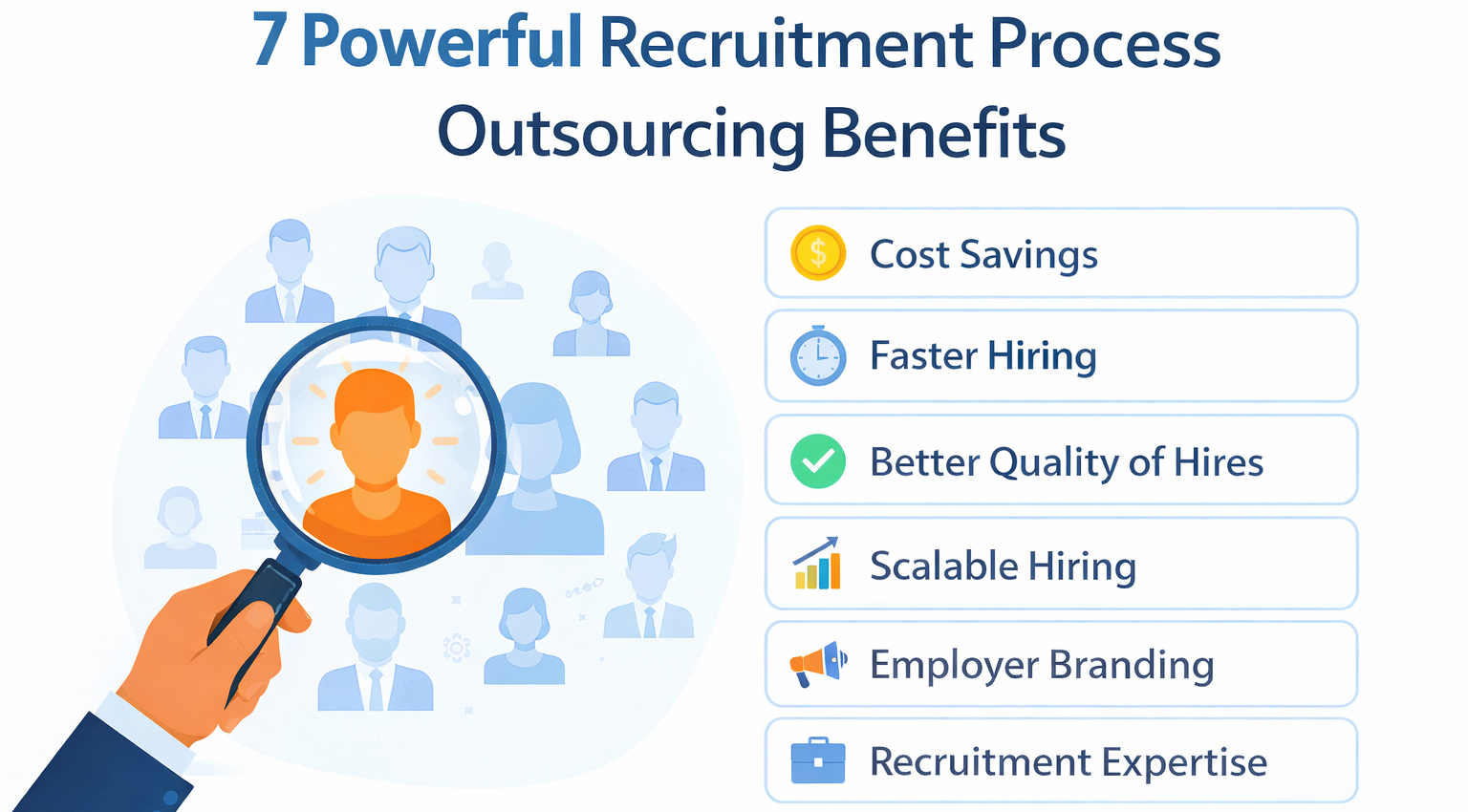
7 Key Benefits of Recruitment Process Outsourcing
1. Reduced Hiring Costs
A streamlined process lowers cost per hire and avoids unnecessary recruitment expenses.
2. Faster Time to Hire
Access to ready talent pools significantly reduces hiring timelines.
3. Improved Candidate Quality
Standardized screening improves accuracy in candidate selection.
4. Scalable Hiring
Businesses can scale recruitment without expanding internal HR teams.
5. Consistent Employer Branding
Candidates experience uniform communication and branding.
6. Access to Recruitment Expertise
Industry-specific hiring knowledge improves success rates.
7. Focus on Core Business Operations
Internal teams can focus on strategic and revenue-generating activities.
Recruitment Process Outsourcing vs Traditional Hiring
| Aspect | RPO Model | Traditional Hiring |
|---|---|---|
| Hiring Approach | Strategic | Transactional |
| Cost Control | Predictable | Variable |
| Scalability | High | Limited |
| Hiring Speed | Faster | Slower |
| Talent Quality | Consistent | Inconsistent |
Common Challenges Solved by Recruitment Outsourcing
Many companies struggle with delayed hiring, unqualified applications, and high employee turnover. Recruitment outsourcing addresses these issues by introducing standardized hiring workflows and data-backed decision-making.
It also reduces dependency on multiple recruitment vendors and improves candidate experience through faster communication and transparent processes. Businesses gain better visibility into recruitment performance while staying compliant with hiring regulations.
When Should Businesses Use RPO?

Recruitment process outsourcing is ideal when:
- Hiring demand is growing rapidly
- Internal HR teams lack recruitment bandwidth
- Specialized or niche roles are difficult to fill
- Recruitment costs are increasing
- Faster and reliable hiring is required
Recruitment Process Outsourcing Trends in 2026
In 2026, recruitment outsourcing is driven by automation, AI-powered sourcing, recruitment analytics, and remote hiring strategies. Businesses using modern RPO solutions gain a competitive advantage by hiring efficiently and reducing long-term talent risks.
Why Businesses Are Shifting to Recruitment Process Outsourcing
Modern businesses operate in an environment where speed, accuracy, and scalability define success. Traditional recruitment methods often struggle to meet these expectations, especially when hiring demand fluctuates or roles require specialized skills. This gap has led many organizations to adopt structured recruitment outsourcing models that bring predictability and efficiency to the hiring process.
One of the primary reasons companies move toward recruitment outsourcing is the growing complexity of talent acquisition. Job markets have become highly competitive, with skilled professionals receiving multiple offers simultaneously. Internal HR teams may lack the time, tools, or market insights needed to compete effectively. An outsourced recruitment partner brings dedicated expertise, established sourcing channels, and refined screening processes that improve hiring outcomes.
Another major factor is cost control. Hiring inefficiencies such as prolonged vacancies, high turnover, and repeated recruitment cycles directly impact business performance. Recruitment outsourcing helps reduce these costs by improving time-to-hire and ensuring better role fit from the start. Instead of paying per hire or dealing with unpredictable recruitment expenses, businesses benefit from more stable and transparent hiring models.
Scalability is also a critical driver. Growing companies often experience sudden spikes in hiring due to expansion, seasonal demand, or new projects. Building internal recruitment capacity for short-term needs is inefficient and expensive. Recruitment outsourcing allows businesses to scale hiring efforts up or down without long-term commitments, ensuring flexibility without operational strain.
Employer branding plays an increasingly important role in attracting quality candidates. Inconsistent communication, delayed responses, or unclear hiring processes can damage a company’s reputation in the talent market. Outsourced recruitment teams follow standardized workflows and brand guidelines, ensuring a consistent and professional candidate experience across all touchpoints.
Finally, recruitment outsourcing supports data-driven decision-making. Modern hiring partners use recruitment analytics to track performance metrics such as time-to-fill, candidate quality, and offer acceptance rates. These insights help businesses continuously refine their hiring strategies, align recruitment with long-term goals, and build reliable talent pipelines.
As hiring challenges continue to evolve, recruitment outsourcing is no longer viewed as a temporary solution. It has become a strategic approach for organizations that want to hire smarter, reduce risk, and stay competitive in dynamic job markets.
How Recruitment Process Outsourcing Improves Hiring Quality Over Time
One of the biggest misconceptions about recruitment outsourcing is that it only focuses on speed or cost reduction. In reality, a well-implemented RPO model significantly improves hiring quality over the long term, which is far more valuable for business stability and growth.
Hiring quality improves when recruitment is treated as a structured process rather than a reactive task. Outsourced recruitment partners follow standardized evaluation criteria, role-specific screening frameworks, and consistent interview methodologies. This reduces bias, minimizes guesswork, and ensures that candidates are assessed based on skills, experience, and cultural alignment rather than urgency alone.
Another key factor is deeper role understanding. Unlike traditional hiring methods where recruiters may work on multiple unrelated roles, recruitment outsourcing teams invest time in understanding business objectives, team dynamics, and role expectations. This context allows them to identify candidates who are not only technically capable but also aligned with long-term organizational goals.
Talent pooling also plays a critical role in improving hiring outcomes. Instead of starting from scratch for every vacancy, recruitment outsourcing partners build and maintain talent pipelines for recurring or critical roles. These pipelines reduce dependency on active job seekers and allow access to passive candidates who are often higher in quality and better suited for strategic positions.
Retention is another area where recruitment outsourcing shows measurable impact. Poor hiring decisions lead to early attrition, increased rehiring costs, and productivity loss. By improving candidate-job fit and setting realistic expectations during the hiring process, recruitment outsourcing reduces early exits and improves employee retention rates.
Data and feedback loops further strengthen hiring quality. Outsourced recruitment teams continuously track performance metrics such as candidate success rates, hiring manager feedback, and post-hire performance indicators. These insights are used to refine sourcing strategies, screening methods, and interview processes over time, creating a continuous improvement cycle.
Additionally, recruitment outsourcing enhances collaboration between HR and business teams. Clear communication channels, defined hiring timelines, and transparent reporting improve alignment and accountability. Hiring managers receive better shortlists, spend less time interviewing unsuitable candidates, and gain confidence in the recruitment process.
Over time, these improvements compound. Businesses experience fewer hiring mistakes, stronger teams, and more predictable recruitment outcomes. This makes recruitment outsourcing not just a tactical decision, but a strategic investment in workforce quality and organizational performance.
Frequently Asked Questions
Is recruitment process outsourcing suitable for small businesses?
Yes, RPO is flexible and works well for small and mid-sized businesses.
How is RPO different from staffing agencies?
RPO focuses on long-term recruitment strategy, while staffing agencies focus on individual placements.
Can recruitment outsourcing be customized?
Yes, RPO models can be tailored based on business size, roles, and hiring volume.
Final Thoughts
Recruitment Process Outsourcing has evolved into a strategic hiring solution rather than a temporary fix. Businesses that adopt recruitment outsourcing in 2026 will hire better talent, reduce hiring costs, and scale with confidence.
For companies looking to build a future-ready workforce, RPO offers a proven and sustainable hiring model.